
Jupiter 8
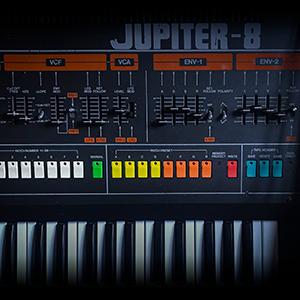
In some ways it's funny that the most polite 80s synth has, four decades on, become the most sought after and expensive. Although the Jupiter 8 has the benefit of some of the most beautiful industrial design ever used on a musical instrument, at first glance it doesn't seem to offer much else to set it apart from its American competitors — 8 voices, each with 2 oscillators, routed through a lowpass filter. It's more softly spoken than its American cousins, without the raunch of the Memorymoog or the OB-Xa, but that, along with the superb engineering inside, turns out to be one of its strengths. It complements other instruments instead of overpowering them, and even when multitracked doesn't lose definition. Its arpeggiator was years ahead of the curve, but unlike contemporary American synths, its innovation did not come at the price of reliability. As evidence of that, ours is pretty well worn on the outside — it has appeared on Top Of The Pops, after all — but is functionally flawless.
Classic: Harold Faltermeyer's Axel F is a good demonstration of the Jupiter's ability to create classic bass and lead tones, but with greater clarity than a typical American synth. That may be one of the reasons it combines so well with acoustic or electric instruments, as shown by its use throughout Marvin Gaye's final album, Midnight Love, as well as on Talk Talk's It's My Life.
Contemporary:Channel Pressure, the concept album from Joel Ford and Oneohtrix Point Never's Daniel Lopatin, uses the Jupiter as one of the primary sound sources across a bewildering range of skewed, parodic takes on styles from funk to R&B to jazz fusion, appropriately using the instrument's 80s heritage to construct and deconstruct the music of that decade.
Club: French producer Joakim has used the Jupiter 8 on dozens of tracks across nearly 20 years, both his own — listen to that warbling lead on Nothing Gold — and on remixes like that of Hearts of Gold for Cut Copy.